Automating Hyperion On-Prem Patching for Oracle's New Monthly CSPU Cadence

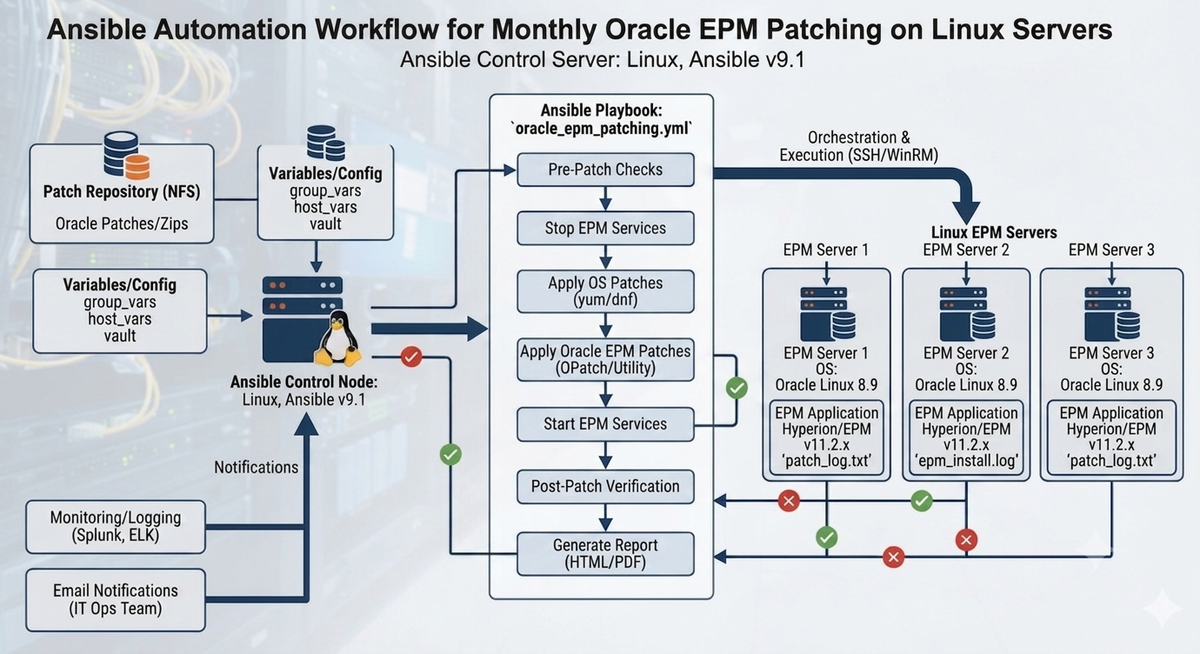
Oracle changed how often on-prem Hyperion environments need patching — and manual processes that survived quarterly cycles won't survive monthly ones. Here's how I automated Java, Opatch, FMW, WebLogic, and OHS patching with three dependency-ordered Ansible playbooks.
The Change
Oracle recently announced a shift in its patching cadence. Alongside the existing quarterly Critical Patch Updates (CPUs), Oracle now also delivers monthly Critical Security Patch Updates (CSPUs), starting May 28, 2026 and landing on the third Tuesday of each month going forward. CSPUs provide focused fixes for critical vulnerabilities in between the quarterly releases, while CPUs remain cumulative, folding in everything released in prior CSPUs.
One detail matters a lot here: this only affects customer-managed environments. Oracle-managed cloud services receive these updates automatically. If you're running on-prem Hyperion, this is squarely your problem to solve.
Full announcement: Oracle Security Blog — Monthly CSPUs Begin May 28, 2026
Why This Changes the Game for On-Prem Hyperion
A patching process that "just barely worked" on a quarterly cycle doesn't scale to a monthly one. Going from 4 patch events a year to as many as 12 isn't just more frequent — it's a different operational problem entirely. Manual patch application, manual validation, manual status tracking: all of it needed to become automated, repeatable, and safe to run without someone babysitting every step.
The Architecture: Three Dependency-Ordered Playbooks
Rather than one giant playbook covering everything, I split this into three:
- Java + Opatch — installs the latest JDK, then upgrades Opatch in both the Middleware Home and the OHS Home
- FMW + WebLogic — applies FMW recommended patches, then the WebLogic Bundle Patch
- OHS — applies OHS-specific patches
This isn't arbitrary. FMW, WebLogic, and OHS patches all assume the latest Opatch version is already in place — so Java/Opatch has to run first, successfully, before anything else. Beyond dependency order, there's a practical reason too: Ansible plays run sequentially and stop on the first failure by default. Bundling everything into one playbook means a failure buried in step 15 makes it hard to tell which layer actually broke. Splitting by dependency tier means I can isolate failures fast, and re-run just the layer that failed instead of re-running the whole patch cycle.
Shared Configuration Across All Three Playbooks
Rather than repeating the same paths in three separate vars: blocks, all three playbooks read from a single group_vars/all.yml file — update a path once, every playbook picks it up automatically.
patchpath: "/path/to/patches/"
opatchdest: "/path/to/middleware/home/"
ohsopatchdest: "/path/to/ohs/home/"
middlewarehome: "/path/to/middleware/home/"
ohshome: "/path/to/ohs/home/"
smtp_host: "<smtp_hostname>"
email_to: "<distribution list>"
One thing worth knowing if you're running this via Ansible Tower/AWX rather than the CLI: group_vars only auto-loads reliably when it sits inside the Project repo itself (where Tower checks out and runs ansible-playbook from) — not inside an SCM-sourced Inventory folder, which is a known unreliable spot for this in AWX/Tower.
Selecting the Target Environment at Run Time
Rather than hardcoding which environment each playbook targets, all three plays use hosts: "{{ target_env }}" — a variable supplied at run time through an Ansible Tower Survey. This means one Job Template can patch DEVHYP or DEVOHS depending on what's selected when the job is launched, instead of maintaining separate hardcoded playbooks per environment.
- name: Java Installation
  hosts: "{{ target_env }}"
In Tower, this is set up as a Job Template Survey: the answer variable name is target_env, and the answer choices must exactly match your real inventory group names. Running from the CLI works the same way, via -e target_env=DEVHYP.
Gotchas Worth Knowing
A few mistakes cost me real debugging time building this — sharing them so they don't cost you the same:
find returns files in arbitrary order. Grabbing the first result (files[0]) without sorting risks picking the wrong file whenever more than one match exists in a staging folder. Fix: sort by modification time first.
src: "{{ (javazipfile.files | sort(attribute='mtime', reverse=true))[0].path }}"
A local vars: block silently shadows shared config. Declaring the same variable name — even blank — inside a play's own vars: overrides the value from group_vars/all.yml, with no warning. I had a comment right next to it saying "vars come from group_vars" and still nearly missed this.
Ansible's copy module with inline content: overwrites the whole file — it doesn't append. If you're building up a log file incrementally across several tasks, copy will wipe out everything written before it. lineinfile with insertafter: EOF is the right tool for appending.
A missing register: fails silently. The task itself runs fine. The problem only shows up later, when a downstream task tries to reference a variable that was never actually created — by which point you're debugging the wrong task.
Two Oracle Homes means two separate OPatch installs. Middleware Home and OHS Home each need OPatch installed independently. It's easy to assume one install covers the whole environment until version-checking both homes proves otherwise.
group_vars cannot drive a play's hosts: line — not even a fully static value with zero templating. I originally tried routing the Tower Survey answer through a lookup table in group_vars/all.yml (mapping a survey label to a real group name). It failed with "variable is undefined," even though that same variable worked fine everywhere else in the playbook. Only true global-scope sources — extra-vars from a Tower Survey, or -e on the CLI — are available early enough to resolve which hosts a play targets. The fix: reference the Survey extra-var directly in hosts:, and make the Survey's answer choices match your real inventory group names exactly.
The WebLogic Bundle Patch: Simulate Before You Commit
One pattern worth calling out specifically: before applying the WebLogic Bundle Patch for real, the playbook runs opatch napply -report first — a simulation that checks for conflicts without actually changing anything — as an async task, then waits for it to complete before running the real opatch napply. Given how disruptive a failed WebLogic patch can be, this simulation step is cheap insurance.
- name: Run opatch simulation (report) for WLS Bundle Patch
  shell:
    chdir: "{{ wls_unzipped.files[0].path }}/binary_patches"
    cmd: "yes y | sh {{ opatchhome }}opatch napply -report -oh {{ middlewarehome }} -phBaseFile linux64_patchlist.txt"
  async: 3600
  poll: 0
  register: wls_report_result

- name: Wait for opatch simulation to complete
  ansible.builtin.async_status:
    jid: "{{ wls_report_result.ansible_job_id }}"
  register: job_result
  until: job_result.finished
  retries: 300
  delay: 5

- name: Run opatch napply after simulation completes successfully
  shell:
    chdir: "{{ wls_unzipped.files[0].path }}/binary_patches"
    cmd: "yes y | sh {{ opatchhome }}opatch napply -oh {{ middlewarehome }} -phBaseFile linux64_patchlist.txt"
  register: wls_napply_result
The async: 3600 / poll: 0 combination kicks off the simulation as a background job rather than blocking the playbook while it runs — patch simulations against a full Middleware Home can take a while. The async_status task then polls for completion (up to 300 retries, 5 seconds apart — 25 minutes max wait) before the real napply is allowed to run. If the simulation reveals a conflict, you catch it here, not mid-patch.
Why Obfuscate Runs After Every Patch
OPatch keeps backup copies of every file it replaces, stored in .patch_storage inside the Oracle Home. Security vulnerability scanners sometimes can't distinguish those old backup files from the live, in-use files — so a scanner matching against known-vulnerable file signatures can flag a fully patched server as unpatched, purely because of a stale backup copy sitting in storage.
opatch util Obfuscate scrambles the contents of those backup files so scanners stop matching against them. It was introduced specifically to cut down false positives from tools scanning for things like log4j.
This matters more than it might seem given the premise of this whole post: an environment now facing monthly CSPU scans can't afford to spend time chasing down false positives twelve times a year instead of four. Obfuscate isn't cleanup — it's part of what makes the monthly cadence sustainable.
Full Playbooks
All three playbooks, the shared config, and setup instructions are on GitHub:
https://github.com/VIKRAM-EPM/vikepmlab/tree/main/hyperion-patching-automation
Takeaway
Oracle's move to monthly CSPUs isn't optional to plan for — it's already happening. If you're maintaining on-prem Hyperion and still patching by hand, the operational math stops working somewhere around month two. Automating the dependency chain — Java/OPatch first, then everything downstream, right down to obfuscating old patch backups so scanners don't flag false positives on the next monthly cycle — turned a process I dreaded into one I can trigger and walk away from.
If you're tackling the same shift, I'd like to hear how you're approaching it — subscribe below or reach out.